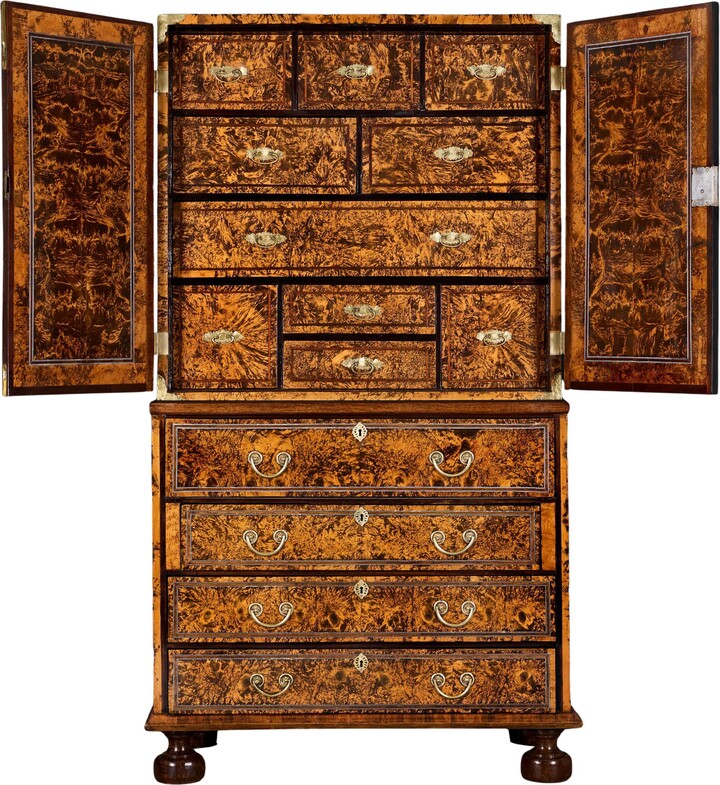
Coxed and Woster A George I Mulberry Secretaire Bureau Attributed To Coxed & Woster
$72887.59
England, circa 1710. An important George I secretaire bureau in finely veneered ‘mulberry wood’ attributed to Coxed & Woster, with satinwood crossbanding, rosewood mouldings and pewter string inlay. The top with parliament hinged doors and oriental brass mounts, opening to reveal an arrangement of ten drawers with original engraved brass handles, the bottom with three drawers below a hinged secretaire desk lined with brown leather and further shelves, all terminated in four bun feet. Height 184.00 centimetres. Width 98.00 centimetres. Depth 52.00 centimetres. Attributed to London cabinetmakers Coxed & Woster, based in the White Swan workshop on the south side of St. Paul’s Churchyard from circa 1690-1736. Similarities can be found in this bureau to a group of examples bearing the trade paper label for G. Coxed and T. Woster. The earliest examples are veneered with what is commonly termed ‘mulberry’, a timber that originally was thought to have come from the mulberry bush or tree but has been recently identified as stained maple, burr elm or sycamore to give a dramatic tortoiseshell effect. In Stalker and Parker's treatise on japanning, a section outlines the technique of using nitric acid or aqua fortis, metal filings and lampblack mixes with linseed oil to produce ‘mulberry wood’. If actual mulberry wood is ebonized to reinforce its markings it does not take the staining effectively whereas with elm, maple and sycamore have more porous parts in the grain which retains the dark streaks to produce this dramatic tortoiseshell-like appearance. It is believed that very few British cabinet makers knew how to create this effect and that the staining process was hotly guarded, with Coxed & Woster being prominent exponents. The popularity of these veneers in the 1690-1730 period is thought to stem from the use of tortoiseshell in the fashionable and influential designs produced by famed French cabinet makers Pierre Golle and André Charles Boulle. (For more in